


 English
 Español
 عربى
عربى

Choosing between walk-behind and ride-on floor scrubber types is one of the most consequential equipment decisions in commercial and industrial facility management. The choice affects cleaning speed, labor efficiency, capital expenditure, operator well-being, and the long-term condition of your floors. Yet many buyers select a machine based on price alone, without considering how the two formats differ in coverage, maneuverability, and operating cost over time.
This guide breaks the walk-behind versus ride-on comparison into concrete criteria: cleaning width, tank capacity, run time, operator strain, and total cost of ownership. It also presents a decision framework you can apply directly to your facility, whether you manage a 5,000-square-foot retail store or a 200,000-square-foot distribution center. Understanding which questions to ask matters more than memorizing spec sheets, because the right answer depends on the building, the schedule, and the cleaning team, not just the machine.
A third common mistake is buying based on the floor area of the building instead of the area actually cleaned during a shift. A warehouse may be 100,000 square feet, but if only the aisles and receiving area are scrubbed, the effective daily area might be 30,000 square feet. Matching the machine to the effective cleaning area is the fastest way to avoid overpaying for capacity you will not use.
Understanding the Two Floor Scrubber Types
Both walk-behind and ride-on scrubbers perform the same core process. They dispense cleaning solution onto the floor, agitate it with rotating brushes or pads, and then vacuum the dirty water into a recovery tank. The differences that matter are machine size, cleaning width, tank capacity, and how the operator controls the unit.
What Defines a Walk-Behind Scrubber
The operator walks behind the machine and steers it with a handle assembly. Walk-behind models typically offer a cleaning width of 17 to 30 inches, solution and recovery tanks between 10 and 40 gallons, and brush motors powered by sealed lead-acid or lithium-ion batteries. They are commonly used in retail stores, schools, medical offices, restaurants, and smaller warehouses where space is tight and routes are short.
What Defines a Ride-On Scrubber
Ride-on scrubbers place the operator on a seated or stand-on platform, allowing the machine to carry a larger battery pack, bigger tanks, and a wider brush deck. Cleaning widths range from 26 to 42 inches or more, and tank capacities frequently reach 40 to 120 gallons. Ride-on models are engineered for facilities above 20,000 to 25,000 square feet, where operators must cover long distances repeatedly during a shift.
Beyond physical dimensions, the two floor scrubber types represent different labor models. A walk-behind scrubber converts one worker into one cleaning station moving at walking speed. A ride-on scrubber gives that same worker a motorized platform, effectively creating a mobile cleaning unit that covers three to four times the area per hour. This labor contrast drives almost every economic comparison between the two types.
Another useful distinction is deck configuration. Walk-behind models often use a single brush or a pair of counter-rotating discs, while ride-on models may carry twin discs or a cylindrical brush system. Cylindrical brushes are particularly effective on uneven surfaces because they sweep and scrub in one pass, but they require more power, which is one reason ride-on platforms tend to deliver stronger brush performance overall.
Walk-Behind vs. Ride-On: Key Differences at a Glance
The table below summarizes the practical differences that matter when comparing floor scrubber types in a real facility.
| Comparison Factor | Walk-Behind Scrubber | Ride-On Scrubber |
|---|---|---|
| Typical cleaning width | 17 to 30 inches | 26 to 42 inches |
| Coverage rate | 10,000 to 25,000 sq ft per hour | 30,000 to 70,000 sq ft per hour |
| Solution and recovery tanks | 10 to 40 gallons total | 40 to 120 gallons total |
| Typical run time | 1.5 to 3 hours | 3 to 6 hours |
| Operator position | Walking behind the machine | Seated or standing on the machine |
| Best suited for | Facilities under 25,000 sq ft, narrow aisles | Large warehouses, plants, logistics centers |
| Typical purchase range | Lower initial investment | Higher initial investment |
These figures are representative ranges across commercial and industrial floor scrubber categories. Actual performance depends on brush type, floor condition, battery chemistry, and operator experience.
Cleaning Speed and Productivity: What the Numbers Show
Coverage rate is the most frequently cited metric when comparing walk-behind and ride-on scrubbers, and it is the metric with the largest gap between the two types. A walk-behind scrubber with a 22-inch brush deck moving at a normal walking pace covers roughly 15,000 to 18,000 square feet per hour under everyday operating conditions. A ride-on scrubber with a 34-inch deck moving at the same speed covers about 32,000 to 38,000 square feet per hour. In practice, ride-on models can push coverage past 50,000 square feet per hour on open warehouse floors with good surface quality.
Example: An 80,000-square-foot cleaning route takes about five hours with a typical walk-behind unit and about two hours with a ride-on unit. Over a five-day week, the ride-on machine saves 15 labor hours. At a wage rate of 18 dollars per hour, that is 270 dollars per week in labor savings, or more than 14,000 dollars per year, before considering overtime and crew scheduling benefits.
The chart above illustrates a typical mid-range comparison. The ride-on unit cleans roughly 2.8 times more area per hour, which changes the staffing equation completely when cleaning time is a bottleneck.
The productivity gap also reshapes the daily cleaning schedule. With a walk-behind unit, cleaning may occupy a three-hour block every night. With a ride-on machine, the same work compresses into one hour, freeing the remaining time for floor coating maintenance, deep spot-cleaning, or releasing the operator earlier. Facilities that compress cleaning into a shorter window also reduce the period during which wet-floor signs are needed, lowering the risk of slips for employees and visitors.
When a Walk-Behind Scrubber Is the Right Choice
Walk-behind scrubbers are not simply smaller versions of ride-on machines. They solve a different operational problem: bringing automated scrubbing to spaces where a large machine cannot work effectively. The following facility profiles consistently favor walk-behind floor scrubber types.
- Spaces under 25,000 square feet where the available cleaning window is long enough for a walking operator.
- Facilities with aisles narrower than the turning radius of a ride-on unit, including retail shelf layouts and racked warehouses.
- Multi-level buildings where the machine must frequently travel in an elevator or be carried up stairs with a lift gate.
- Operations with limited storage space or no loading dock for unloading a heavy ride-on machine.
Restricted Aisle Widths and Dense Layouts
Retail shelving, warehouse racking, hospital corridors, and food service kitchens all contain aisles narrower than the typical ride-on turning circle. A walk-behind scrubber with an 18- to 24-inch deck can navigate doorways, elevators, and tight corners that are impossible for a seated unit. In a 40,000-square-foot facility where 60 percent of the space consists of aisles narrower than eight feet, a ride-on scrubber spends more time maneuvering and reversing than actually cleaning, which cancels out its speed advantage.
Multi-Level and Interior-Limited Facilities
If your cleaning route requires moving between floors via a freight elevator, or if the facility has no ground-level storage for a large machine, a walk-behind model is the practical choice. A typical walk-behind scrubber weighs 350 to 700 pounds and can be transported in a standard cargo van. Ride-on scrubbers typically weigh 1,500 pounds or more and often require a loading dock, ramp system, or dedicated trailer for transport between sites.
Budget-Conscious Equipment Plans
The purchase price of a walk-behind scrubber is substantially lower than that of a ride-on model with comparable brush technology. For a facility that cleans less than 20,000 square feet per day, the extra spending on a ride-on unit usually cannot be recovered through labor savings, because the operator already has enough spare time to complete the route. Walk-behind models also have simpler drive systems and fewer components, which reduces long-term service exposure.
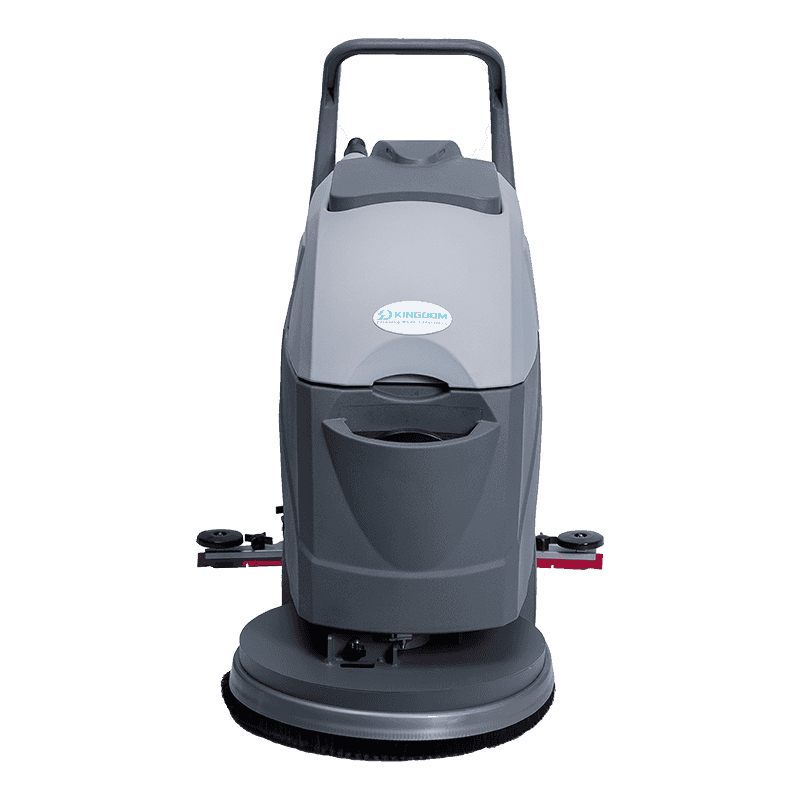 JD45 Hand Push Electric Floor Scrubber for Compact Daily CleaningThe JD45 walk-behind scrubber offers a 510mm brush width and 45L solution tank, designed for facilities under 20,000 sq ft. Simple controls and adjustable brush pressure make it a cost-efficient daily cleaning choice.View Product →
Compact walk-behind models such as the JD45 hand-push electric commercial scrubber illustrate how this category balances brush width, tank size, and ease of use for daily commercial cleaning, without consuming large amounts of storage space or requiring specialized maintenance skills.
Maintenance is another area where walk-behind machines have a structural advantage. Their drive systems are simpler, with fewer moving parts exposed to dust and water. Most routine service tasks, such as replacing squeegee blades, checking brush wear, and cleaning the recovery tank, can be completed by in-house staff without special tools. This matters for facilities that do not have an on-site maintenance department and rely on external service providers.
When a Ride-On Scrubber Is the Better Investment
Ride-on scrubbers are designed for continuous, high-throughput cleaning. They are not walk-behind machines with a seat attached; the entire platform, from the frame to the battery compartment, is engineered for longer run times, greater payload capacity, and faster travel between cleaning zones.
Large Single-Level Facilities
Distribution centers, manufacturing plants, parking structures, and big-box retail locations routinely exceed 50,000 square feet of hard flooring. At this scale, an operator on a ride-on unit spends less than half the time needed with a walk-behind model. Cleaning becomes a scheduled and predictable operation instead of a multi-hour physical grind. In facilities that run two or three shifts, the higher coverage rate also means cleaning can be completed in a dedicated hour without interfering with production or logistics traffic.
Extended Shifts and Multi-Shift Cleaning
Large ride-on scrubbers carry 40 to 120 gallons of solution and recovery capacity, allowing the machine to run for three to six hours before it needs to stop for a refill and dump cycle. A walk-behind unit with a 20-gallon tank may require two or three fill-and-empty stops during the same period. For a facility that must present a clean floor every morning, the difference in downtime directly affects whether the cleaning crew finishes on schedule.
Operator Comfort and Retention
Floor scrubbing is repetitive work. Operators who walk behind a machine for six hours a day experience more fatigue than those who ride. Facilities that switch from walk-behind to ride-on equipment often report better operator focus, fewer physical complaints, and lower crew turnover. From a management perspective, reducing the physical strain of the job makes it easier to attract and retain reliable cleaning staff.
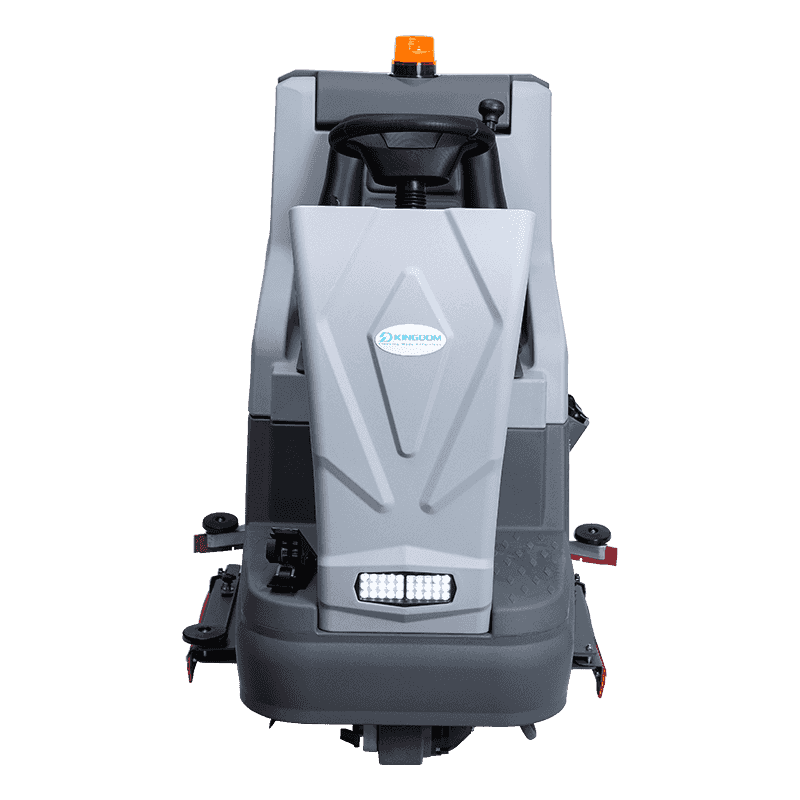 JD160 Ride-On Electric Floor Scrubber for Large-Scale CleaningThe JD160 ride-on scrubber combines a large tank capacity and full LCD controls to reduce operator fatigue, making it suitable for large facilities where consistent floor cleaning with a small team is required.View Product →
Ride-on models such as the JD160 electric ride-on commercial scrubber demonstrate how this product category combines deck width, tank capacity, and operator ergonomics for facilities that need to keep a large floor consistently clean with a small team.
In multi-shift operations, the choice of floor scrubber type also affects staffing flexibility. A ride-on machine allows one operator to cover the entire building in a single pass, which makes it easier to schedule cleaning during production breaks or overnight windows. It also reduces the supervision burden, because the operator spends less time transitioning between zones and more time in continuous cleaning motion.
Total Cost of Ownership: Beyond the Purchase Price
Comparing floor scrubber types by price alone is misleading. The purchase price typically represents only 25 to 40 percent of total ownership costs over a five-year period. Labor, battery replacement, maintenance, and consumables make up the rest. The table below outlines how costs accumulate differently for each type.
| Cost Component | Walk-Behind Scrubber | Ride-On Scrubber |
|---|---|---|
| Initial purchase price | Lower, with entry-level models available | Higher, especially with lithium-ion batteries |
| Hourly labor cost per route | Higher, because more hours are needed | Lower, because the same area is cleaned faster |
| Battery replacement | Every 2 to 3 years for lead-acid batteries | Larger pack, replacement cost is higher |
| Squeegee blades and pads | Lower material cost due to smaller widths | Higher material cost, but coverage per set is larger |
| Maintenance complexity | Simpler drive system, lower service fees | More complex systems, higher service fees |
| Downtime risk | Easier to keep a spare unit on site | More disruptive when the main unit is out of service |
The practical takeaway is that the cheapest machine on paper can become the most expensive machine in operation when labor hours, downtime, and backlog costs are factored in. As cleaning efficiency upgrades across multiple industries reduce the total cost of floor care, the economic argument for the right-sized scrubber becomes stronger every year.
Resale value is another consideration. Ride-on scrubbers retain a higher absolute resale value because the used market for large cleaning equipment is active, especially in logistics regions. Walk-behind machines hold a smaller absolute value but are easier to sell locally. If you plan to expand or relocate within five years, factoring in resale and trade-in terms will give you a truer cost comparison.
A Practical Decision Framework for Selecting a Floor Scrubber Type
To move from theory to a concrete purchase decision, run your facility through the five steps below. This framework reflects how cleaning managers and operations directors typically evaluate the two floor scrubber types.
- Measure the total hard-floor area cleaned per day, not the total building area.
- Map the route: note door widths, shelf heights, ramps, and elevator access.
- Calculate the available cleaning window per shift, including setup and maintenance time.
- Estimate current weekly labor cost by multiplying hours by the operator wage rate.
- Compare the annual labor saving of a ride-on unit against its higher purchase and service cost.
The flowchart summarizes the most common selection logic. Facilities near the 25,000-square-foot boundary should test both floor scrubber types with a rental or demonstration unit before committing to a purchase, because local conditions such as floor slope, drainage, and racking depth can shift the balance.
If the data sheet still leaves room for doubt, organize a side-by-side trial. Most manufacturers and dealers offer demonstration units that can be run on your floor for a day. Pay attention to how the machine behaves on expansion joints, near floor drains, and at the end of long aisles, because these details often decide whether a machine fits the daily reality of your building.
Frequently Asked Questions
Q1: What is the difference between walk-behind and ride-on floor scrubber types?
The main difference is operator positioning and production capacity. Walk-behind scrubbers require the operator to walk behind the machine and are best for spaces under 25,000 square feet. Ride-on scrubbers let the operator ride on the machine, covering three to four times more area per hour, and are engineered for larger facilities.
Q2: Which floor scrubber type covers more area per hour?
Ride-on scrubbers cover significantly more area. A typical walk-behind unit cleans 10,000 to 25,000 square feet per hour, while a ride-on unit covers 30,000 to 70,000 square feet per hour, depending on deck width, travel speed, and floor conditions.
Q3: Are ride-on scrubbers worth the higher purchase price?
They are worth the price when daily cleaning area is large enough that saved labor hours exceed the extra ownership costs. For a 60,000-square-foot facility cleaned daily, the labor savings often offset the higher purchase price within the first 12 to 18 months of operation.
Q4: Can a walk-behind scrubber replace a ride-on unit?
It depends on the available cleaning window. If the cleaning crew has enough time to finish the route with a walk-behind machine, replacement is possible and can reduce capital cost. If not, switching to a ride-on unit is the only way to close the coverage gap without adding staff or extending shifts.
Q5: Does aisle width influence the choice of scrubber type?
Yes. A ride-on scrubber generally needs an 8- to 12-foot turning radius. If the primary aisles are narrower than that, a walk-behind scrubber, which turns in a much smaller radius, is more practical even in a larger building.
Q6: How long do batteries last in each floor scrubber type?
Battery life depends on chemistry and usage. Lead-acid batteries typically last 800 to 1,200 charge cycles, which corresponds to two to three years in daily operation. Lithium-ion batteries can last 2,000 to 3,000 cycles and hold their charge better near the end of life, but the replacement cost for a large ride-on lithium pack is substantially higher.
