


 English
 Español
 عربى
عربى

Floor scrubbers come in two power variants: battery and corded. Both scrub, rinse, and recover dirty water with the same three-stage cleaning action, but the way they receive energy changes almost everything about how you plan a shift. The choice affects purchase cost, daily labor, safety, maintenance, and even the width of the aisles you can clean comfortably. This article compares battery-powered and corded floor scrubbers across the factors that matter most in real facilities, then provides a practical framework for choosing the right machine.
For most facility managers, the question is not which technology cleans better, because both can produce a spotless floor. The real question is which technology fits the building, the shift pattern, and the budget over a five-year ownership period.
How Battery and Corded Floor Scrubbers Deliver Power
A battery floor scrubber stores electrical energy in deep-cycle lead-acid or lithium packs. The pack feeds a motor controller that powers three loads: the brush motor, the squeegee vacuum motor, and, on self-propelled models, the traction drive. Battery voltage falls as the pack discharges, so older lead-acid machines gradually lose brush speed near the end of a shift. Lithium iron phosphate packs hold a much flatter discharge curve and keep cleaning performance consistent until the low-voltage cutoff.
A corded floor scrubber draws alternating current from a wall outlet. The machine either runs AC motors directly or converts AC to DC through a rectifier. Because the supply is effectively unlimited, brush pressure, pad speed, and vacuum lift remain at their rated values for the entire shift. The tradeoff is the tether: the machine can only work within reach of its power cable, and extension cable quality directly affects motor torque.
Components You Will Need to Compare
- Battery system: deep-cycle pack, charger, battery management electronics, DC motor controller
- Corded system: power cable, plug, GFCI protection, AC motor or rectifier
- Shared components: brush deck, solution tank, recovery tank, squeegee assembly
| Comparison Point | Battery Scrubber | Corded Scrubber |
|---|---|---|
| Typical input | 12V to 48V DC pack | 110V to 240V AC outlet |
| Power consistency | Declines as pack discharges | Steady while plugged in |
| Charging requirement | 6 to 10 hours for lead-acid | None |
| Cable restraint | None | 15 to 25 m typical |
| Best suited to | Large open floors | Compact areas near outlets |
Runtime, Coverage, and Shift Planning
Runtime is the deciding factor for large facilities. A battery walk-behind scrubber with lead-acid cells typically delivers 2.5 to 3.5 hours of continuous cleaning; a lithium version can reach 4 hours. If your daily routine requires six hours of scrubbing, you need a mid-shift battery swap, an onboard opportunity charger, or a second machine. Every minute spent charging is a minute not cleaning.
Corded machines have no runtime ceiling, but they have a reach ceiling. Most units carry a 15-to-25-meter cable, and the operator must relocate the plug whenever the machine reaches the end of that radius. For a 1,500 sq m retail floor with outlets on every column, cable handling is minor. For a 10,000 sq m warehouse with racks and loading bays, the operator can lose 20 minutes per shift to unplugging, dragging, and replugging the cable, and that time comes directly out of productivity.
A simple way to estimate your need is to multiply planned cleaning hours by machine speed and brush width. A walk-behind scrubber with a 40 cm brush traveling at 3 km/h covers roughly 1,200 sq m per hour. If your target area exceeds 3,000 sq m, battery power with a spare pack usually outperforms a corded unit once cable handling is included in the calculation.
Total Cost of Ownership
Purchase price is the most visible number, but it is not the whole picture. A corded scrubber typically costs 20 to 30 percent less than an equivalent battery model because it skips the battery pack, charger, and battery management electronics. Over a five-year life, however, the battery machine incurs a major expense that the corded machine never sees: battery replacement. A lead-acid pack for a walk-behind scrubber costs roughly 25 to 35 percent of the original machine price and lasts about 1,000 to 1,500 charge cycles in daily service.
Energy costs are close. A corded machine running a 1.5 kW brush and vacuum motor for six hours consumes about 9 kWh. Recharging the same machine's battery uses a similar amount of electricity plus a small charger loss. The meaningful difference is labor: battery operators spend time daily watering cells, cleaning terminals, and checking charge states, while corded operators spend that time managing cables and outlets. In a facility where labor rates are high, the corded machine's time overhead can outweigh its lower purchase price.
| Cost Factor | Battery Scrubber | Corded Scrubber |
|---|---|---|
| Purchase price | Higher by 20-30 percent | Lower |
| Battery replacement | Every 3-5 years | None |
| Energy per 6-hour shift | About 9-12 kWh for recharge | About 9-12 kWh direct |
| Daily operator overhead | Charging and battery inspection | Cable handling and outlet changes |
| Spare parts risk | Charger, connectors, cells | Cable, plug, motor brushes |
As the demand for efficient floor cleaning grows, operations in many industries are shifting toward battery-powered designs that cut labor waste and extend coverage between shifts.
Maintenance and Service Life
Battery maintenance is not difficult, but it is continuous. Lead-acid cells need distilled water top-ups every one to two weeks, terminal cleaning to prevent corrosion, and an equalization charge every few months. Batteries also age faster in hot environments; every temperature increase accelerates chemical degradation, so a battery room without ventilation shortens pack life noticeably. Lithium packs reduce daily chores to plugging in the charger, but they carry a higher replacement cost when they eventually fail.
Corded machines have a different maintenance profile. The power cable is a wear item from the first shift: it is dragged over wet concrete, run over by pallet jacks, and wrapped around machine corners. A facility that scrubs daily can expect to replace a cable every one to two years. Motor brushes, plugs, and connectors also need periodic inspection. The advantage is that these repairs are quick and do not require battery expertise.
From a staffing perspective, a shop with a maintenance team familiar with electrical systems will find corded machines easy to service. A facility that wants the cleaning crew to arrive, charge, and leave with minimal technical involvement often accepts battery care as the price of cable-free freedom.
For industrial plants that prefer battery operation, a walk-behind industrial auto scrubber with a durable brush drive is a practical match for daily production-area cleaning.
Maneuverability, Safety, and Facility Constraints
Cable length is not just a performance limitation; it is a safety issue. A live cable stretched across a wet floor is a slip hazard, and a damaged cord on a damp surface can create a shock risk. Battery machines eliminate trailing cables entirely, which is why food plants, hospitals, and parking garages usually choose battery power. Corded machines, by contrast, require discipline: GFCI outlets, daily cable inspections, and proper storage so the cable does not wear at the plug.
Weight is the hidden difference. A battery pack adds 100 to 300 kg to a scrubber depending on the model, which affects ramps, trailer loading, and elevator use. Corded machines are lighter and easier to transport, but they make up for it with a cable that snags on racks, columns, and dock doors. For an operation cleaning long aisles or multiple rooms on one level, the battery machine's freedom outweighs its weight.
Advantages at a glance:
- Choose battery when: you have an open floor plan, no outlets in the center, wet areas, multi-room routes, or covered outdoor zones
- Choose corded when: the building is small, outlets are spaced every 15-20 m, charger storage is limited, or budget constraints dominate
Facilities with a mix of conditions sometimes buy both: a corded machine for the front retail area and a battery machine for the warehouse. This hybrid approach is common in distribution centers and is worth considering if your floor is divided into zones with very different power access.
Does the Power Source Change Cleaning Results?
Both configurations can produce identical clean floors when the machines are new and the batteries are fully charged. Brush pressure, pad speed, solution flow, and vacuum lift are determined by motor sizing, not by whether the power comes from a battery or a socket. The difference appears at the edges of the shift.
A lead-acid battery machine loses cleaning performance in the final 20 to 30 minutes of discharge. The brush motor slows slightly, the vacuum motor drops, and the squeegee may leave a streaky film, especially on smooth tile. Lithium batteries hold rated voltage much longer and have largely closed this gap on modern machines. Corded units keep full vacuum lift all day, but they are vulnerable to extension cables that are too long or too thin; a 50-meter roll of thin-gauge cable can sap enough voltage to weaken brush torque noticeably.
Water pickup is the most visible sign of power fade. Operators who track squeegee streak complaints usually find that the last batch of the day, running on a tired battery, produces the most rewashing. Scheduling the battery machine for the beginning of the shift and using a corded unit for the final pass is one practical way to keep quality consistent.
In retail and hospitality environments, a hand-push electric commercial scrubber with stable speed control helps operators keep results consistent without constant cable checks.
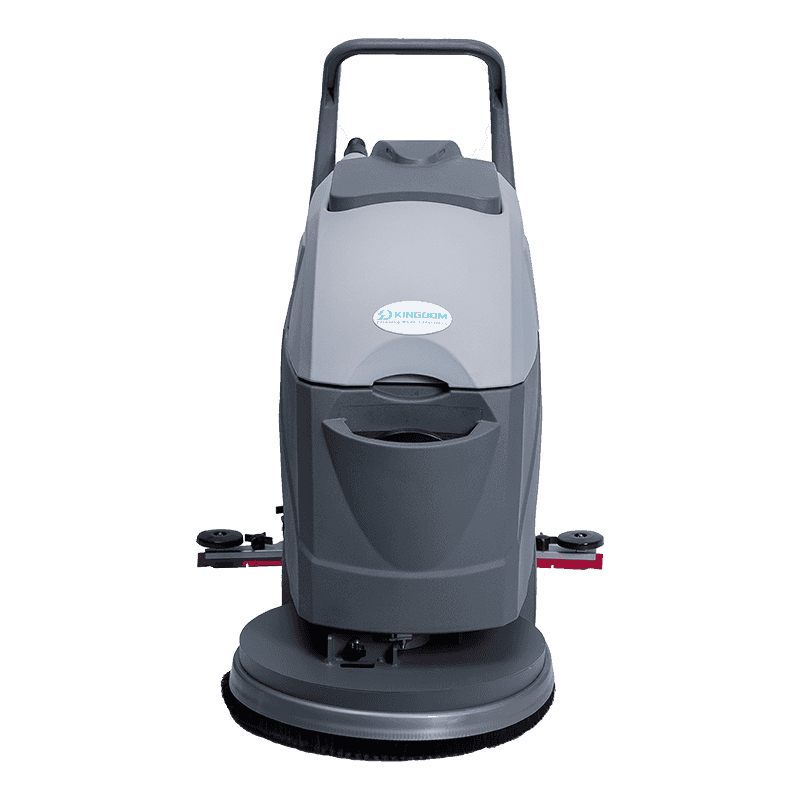 JD45 Hand Push Electric Scrubber with Battery PowerThis battery-powered walk-behind scrubber suits retail and hospitality spaces, offering adjustable brush pressure and long runtime. Its specs and cost-effectiveness make it a practical choice for consistent floor care without cable management.View Product →
Decision Framework: Battery or Corded for Your Facility?
Match the power source to the floor plan and the shift, not to the machine's sticker price. The flowchart below summarizes the most common decision paths.
Checklist to confirm your choice:
- Total daily area above 3,000 sq m: battery, or corded with many outlets
- Outlet spacing closer than 20 m: corded remains viable
- Shift longer than 5 hours: battery with spare pack, or corded
- Frequent relocation between rooms: battery saves time
- Budget for battery replacement in year 3 to 5: include it in the comparison
One facility study illustrates the tradeoff. A distribution center cleaning 8,000 sq m each night switched from a corded walk-behind to a battery walk-behind and measured a 30 minute reduction in shift time, almost all of it from eliminated cable moves. The same facility later installed additional floor outlets and found the corded machine returned to productivity for the office wing, where runs were short and charging space was limited.
For compact commercial spaces, a mini folding battery scrubber removes daily mopping without long cable runs.
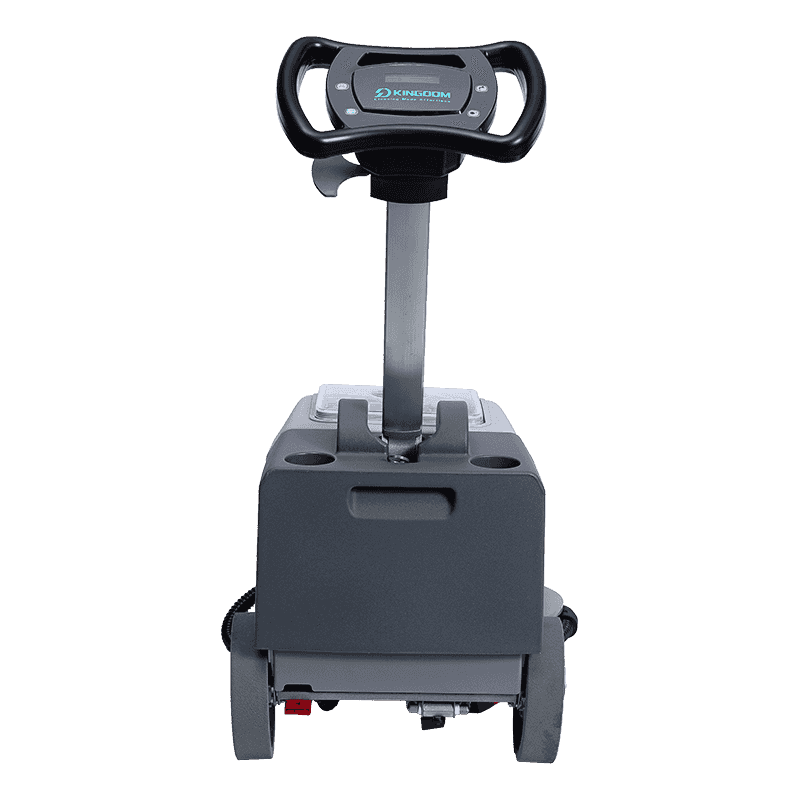 JD35 Compact Folding Battery Floor ScrubberA lightweight, folding scrubber with a 180-degree rotating brush head and removable tanks, ideal for small commercial areas. Its lithium battery and automatic controls provide convenient, cable-free daily cleaning.View Product →
There is no universal winner. Corded machines win on price and simplicity when the building gives them constant access to outlets. Battery machines win on freedom and consistency when the floor is large, open, or wet. Use your floor plan, shift length, and maintenance capability as the deciding criteria, and the right choice becomes clear. A cleaning equipment manufacturer with experience in both configurations can help you match machine specifications to your site.
FAQ: Battery vs. Corded Floor Scrubbers
Q1: How long does a battery floor scrubber run on one charge?
A typical walk-behind model runs 2.5 to 4 hours per charge. Runtime depends on brush pressure, solution flow, floor friction, and battery chemistry. Lithium packs run longer and hold power more steadily than lead-acid packs.
Q2: Are corded floor scrubbers more powerful than battery models?
Corded machines deliver continuous rated power, so brush speed and vacuum lift stay constant all day. Battery machines with lead-acid packs lose some power near the end of the charge; lithium-equipped models come very close to corded consistency.
Q3: How much does battery replacement cost?
Replacement packs usually cost 25 to 35 percent of the original machine price. With proper daily charging and watering, most packs last 3 to 5 years. Corded machines have no battery replacement cost at all.
Q4: Can I convert a corded scrubber to battery power?
Conversion is rarely economical. You would need a deep-cycle pack, a charger, a compatible motor controller, and frame reinforcement to handle the added weight. Buying a machine designed from the start for one power source is almost always cheaper and safer.
Q5: Which option is safer for wet floors?
Battery machines remove the trip and shock hazard of a live cable. If you use a corded machine on wet floors, install GFCI protection, inspect the cable daily, and keep the cable off the wet surface wherever possible.
