


 English
 Español
 عربى


A floor scrubber battery is the most expensive wear item on the machine, and it is also the component most often damaged by habits that look harmless: a top-up charge during the lunch break, a machine parked on a sunlit loading dock in July, or a flooded pack left half empty for three weeks. The failure is rarely sudden. It arrives as a slow drift from six hours of runtime to five, then four, until the operator starts finishing the route with a mop.
This guide is written for the people who manage those machines: facility teams running ride-on scrubbers across large warehouses, contractors with a mixed fleet of walk-behind units, and maintenance staff who inherit a charger, a water can, and very little documentation. It covers what to check, how to charge, how to water, and when replacement is genuinely the cheaper decision.
Working principle: every lead-acid and lithium pack loses capacity through the same two mechanisms, deep discharge and heat. A routine that controls those two variables does more for runtime than any additive, gadget, or upgrade.
Why Battery Care Decides Uptime and Cost Per Square Metre
A battery pack typically represents a significant share of a scrubber's total value, and on a machine working two shifts a day, a replacement usually lands within two to three years. Because the pack is charged rather than refuelled, its condition is invisible until the moment it stops carrying the machine through a shift. Cleaning managers rarely notice the decline in isolation; they notice a crew that suddenly needs a second hour to finish the same aisle.
The chemistry in the machine determines which habits matter. The table below summarises the published ranges and the maintenance realities behind each option.
| Chemistry | Published cycle life | Watering | Charging habit that suits it | Main risk |
|---|---|---|---|---|
| Flooded lead-acid | 1,000 to 1,500 at 50 percent depth | Every 5 to 10 charge cycles | Full charge after every shift | Plates exposed to air |
| AGM or gel | 500 to 800 | None, sealed | Full charge, no equalising | Over-voltage from a flooded-type charger |
| Lithium-ion | 2,000 to 3,500 | None, sealed | Partial charges are acceptable | Charging below freezing |
Three cost paths follow from poor care: earlier capital replacement, longer charging downtime because a weak pack needs more time to reach the same runtime, and labour spent diagnosing faults that a five-minute check would have prevented.
How to Build a Daily and Weekly Care Routine
Consistency matters more than intensity. A short routine attached to shift start and shift end is easier to sustain than a deep inspection nobody has time for.
Before the Shift
- Read the state-of-charge indicator and record it, so trends become visible over weeks.
- Look at the terminals for white crust, discoloured cable ends, or loose nuts.
- Check that the charger plug and socket are dry and free of cleaning solution.
- Wipe any liquid from the top of a flooded battery before opening a cap.
After the Shift
- Park on a level surface and switch the machine off completely.
- Open the recovery tank lid so moisture can escape overnight.
- Connect the charger and confirm the indicator shows an active charge.
- Charge to completion rather than disconnecting at an arbitrary hour.
- Log the finish time and any interruption, which is the first clue when runtime drops.
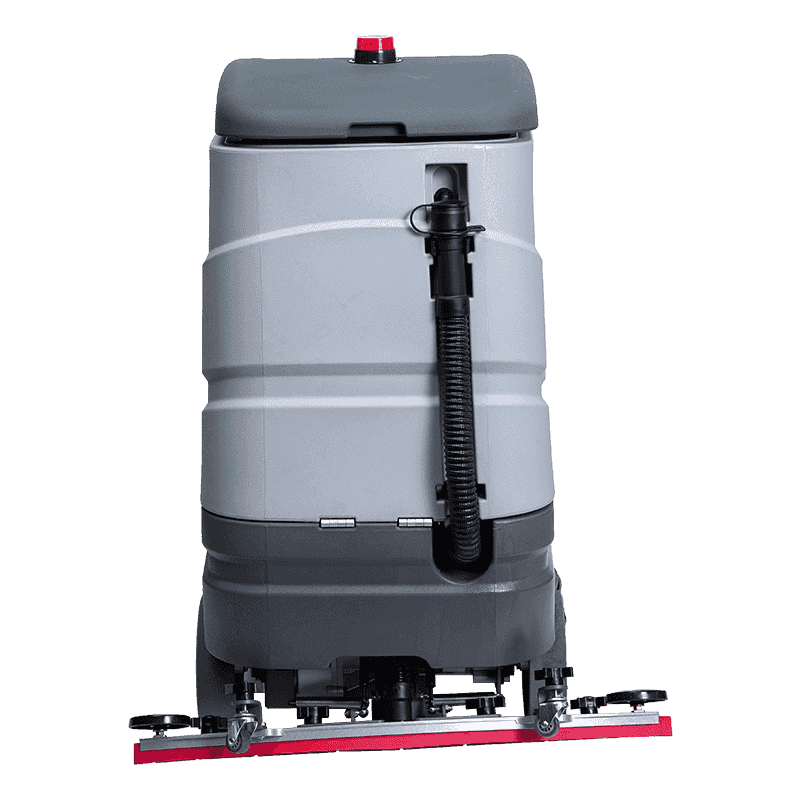 JD75 Ride-On Industrial Automatic Floor ScrubberA compact ride-on option with 75 L clean and 88 L recovery tanks for shift-based cleaning routines and monthly performance comparisons.View Product →
Weekly tasks add watering checks for flooded packs, a terminal clean with a dry brush and a mild solution, and a visual inspection of the charger cable for cuts. Monthly work should compare performance with the previous month rather than judging a battery on a single shift.
The Monthly Audit
A repeatable audit takes about fifteen minutes per machine and produces the evidence needed before a capital request is written.
How to Charge Without Shortening Battery Life
Most premature battery failures are charging failures in disguise. Charging is not a neutral act; every cycle consumes a slice of the pack's design life, and how deep that slice is depends on where the charge begins and ends.
The 80 Percent Habit
For lead-acid packs, routine discharge beyond roughly half of rated capacity accelerates plate wear. Where a shift permits, plan routes so the machine returns with 40 to 60 percent remaining, then charge fully. The shorter, shallower cycle adds hundreds of usable cycles compared with routinely running the pack flat.
Where the Charger Lives
- Charge in a ventilated, dry area between roughly 10 and 30 degrees Celsius.
- Keep the charger off wet floors and away from floor drains.
- Do not stack tools or spare parts on the charger housing; it needs airflow.
- Use the charger matched to the chemistry, never a mismatched unit for convenience.
Opportunity Charging Versus Deep Cycles
Short top-ups during breaks work well for lithium packs and are acceptable for lead-acid packs that will complete a full charge afterwards. What damages lead-acid cells is repeated partial charging without an occasional full cycle, which lets acid stratify and leaves sulphate crystals to harden on the plates.
Rule of thumb: a lead-acid pack benefits from at least one uninterrupted full charge every week, even if daily work only requires partial top-ups.
How to Keep Flooded Lead-Acid Cells Alive
Flooded packs still power a large share of ride-on and walk-behind scrubbers because they tolerate hard duty and cost less per cycle. Their weakness is that they depend on a person opening the caps.
Watering Rules
- Water only after charging, when the electrolyte has expanded to its working level.
- Use distilled or deionised water; tap water leaves mineral deposits on plates.
- Never fill above the level indicator, because expansion during charging will overflow.
- Never let the plates stand dry, which permanently removes capacity.
- Check levels every five to ten charge cycles, and more often in hot weather.
Terminals, Cables, and Equalising
White crust on a terminal is acid mist escaping during charge. Clean it with a dry brush, apply a thin protective coating designed for battery terminals, and re-tighten the connection to the torque stated in the manual. Loose terminals create heat, and heat at a connection is a fire risk. An equalising charge, run at the interval the manufacturer specifies, stirs the electrolyte and helps reverse mild stratification.
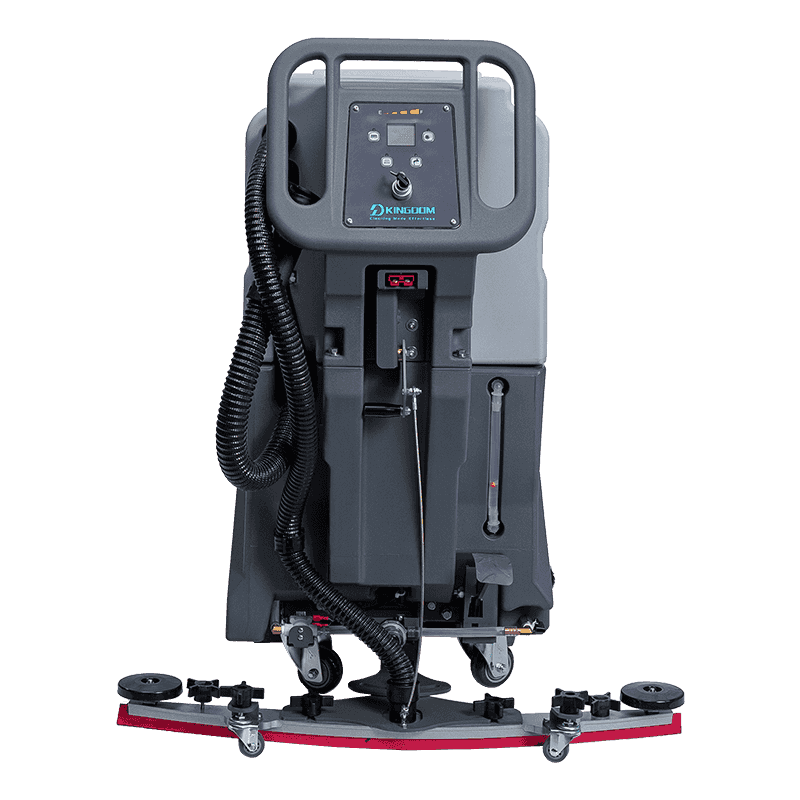 JD55 Walk-Behind Industrial Auto Floor ScrubberFor narrow passages and routine battery care, this 55 L walk-behind scrubber offers adjustable brush pressure and ECO operation.View Product →
Safety: charge flooded packs away from sparks, wear eye protection when checking levels, and never lean over a battery during the final hours of a charge.
What Changes When the Machine Runs on Lithium-Ion
Lithium packs remove the watering routine and reward different habits. Partial charging is normal, storage at a middle charge is preferred, and the battery management system protects the cells from most abusive conditions, which is why a modern lead-acid alternative and a lithium option are rarely interchangeable on cost alone; the two are compared here on cycle life and charging behaviour.
- Partial charges after each shift are acceptable; full discharge is not.
- Store at 40 to 60 percent charge if the machine will idle for more than a month.
- Do not charge a pack that has just come in from freezing conditions; let it reach room temperature first.
- Keep the original charger, since the management system communicates with it during charging.
Charger Compatibility
Lithium chargers follow a different profile from lead-acid units, and swapping them can trigger a fault code or, worse, a silent partial charge that leaves the pack unbalanced. Label each charger with the machine it belongs to and treat the pair as one asset.
Which Symptoms Point to the Battery and Which Do Not
Not every loss of runtime is a battery problem. Squeegee wear, a clogged solution filter, and a dull brush all increase the energy needed per square metre, which looks identical on the hour meter.
| Symptom | Likely cause | Check first |
|---|---|---|
| Runtime drops 20 to 30 percent within weeks | Stratified electrolyte or one weak cell | Voltage of each battery in the pack, measured after rest |
| Machine cuts out under brush load | Voltage sag from an aged pack | Voltage under load, not at rest |
| Charger runs hot or never finishes | Sulphated plates or a failing charger | Charger output and pack temperature |
| Battery case hot after charging | Overcharging or a shorted cell | Charge profile, ventilation, and charger setting |
| Solution and recovery tanks empty too fast | Not battery related | Float valve, hoses, and squeegee alignment |
Checks Before You Order a Replacement
- Confirm the charger delivers the rated output and stops at the correct point.
- Compare pack voltage at rest with the specification for a fully charged unit.
- Run a timed discharge test on a level floor with a known brush pressure.
- Inspect and clean every connection, then repeat the test before spending money.
How Temperature, Storage, and Water Quality Change the Rules
Heat is the quiet accelerator. A pack that runs at 35 degrees Celsius ages noticeably faster than one kept near 25, and a scrubber parked beside a furnace or under a metal roof in summer lives in exactly that condition.
- Charge in the coolest available bay, not next to a drying oven or boiler room.
- Allow a hot pack to rest before charging; charging adds heat on top of heat.
- For storage beyond a month, leave lead-acid packs fully charged and lithium packs at mid charge.
- Disconnect the pack or use the isolation switch so parasitic loads cannot drain it flat.
- Use distilled water only; hard water scales plates and reduces conductivity over time.
Seasonal planning helps as well. If winter brings cold docks, expect a temporary runtime reduction of 10 to 20 percent from the same pack and avoid diagnosing a fault until temperatures normalise.
When to Replace a Battery and How to Plan Fleet Replacement
Replacement is justified when a pack can no longer complete the required shift on a full charge, not when the calendar suggests it. A timed discharge test converts that judgement from opinion into a number.
- Capacity below 80 percent of rated output on a controlled test is a common replacement threshold for daily duty.
- Repeat failures in the same pack position after equalising point to a cell at end of life.
- Case swelling or acid weeping at a seam means the unit should be withdrawn immediately.
- Rising charge time with falling runtime signals internal resistance climbing, not a charger fault.
Fleet planning works best when replacement is staggered. Testing every pack in the same month reveals which units are genuinely weak, and spreading purchases across quarters keeps capital spending predictable. Matching the next order to the duty cycle, rather than to the largest available pack, avoids paying for capacity the route never uses; the ride-on floor scrubber range shows how pack size scales with deck width and tank volume.
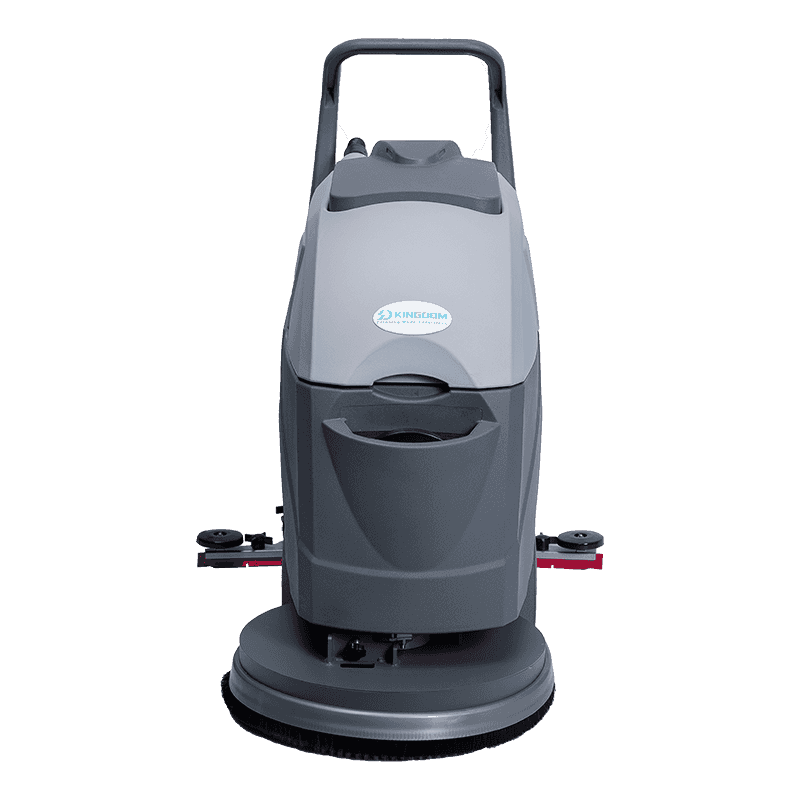 JD45 Hand Push Electric Commercial Floor ScrubberA lightweight 45 L hand-push scrubber for commercial floors, suited to daily charging habits and staggered fleet replacement planning.View Product →
Frequently Asked Questions
Q1: How often should a floor scrubber battery be charged?
After every shift of use. Lead-acid packs should finish a complete charge cycle, while lithium packs accept partial top-ups without harm. Leaving a pack discharged overnight is the single most damaging habit in daily operation.
Q2: Can I top up a flooded battery with tap water in an emergency?
Only as a short-term measure, and only enough to cover the plates. Mineral content in tap water deposits on plates and reduces capacity, so replace it with a proper full charge and distilled water as soon as possible.
Q3: Why does the runtime drop in winter?
Cold electrolyte slows the chemical reaction and temporarily reduces usable capacity by roughly 10 to 20 percent. The effect reverses as the pack warms, so it should not be treated as a fault unless the loss persists in mild conditions.
Q4: Is it safe to leave the charger connected for days?
Modern chargers switch to a float or maintenance mode after the main charge ends. Older units may keep trickling current into the pack, which shortens life, so check the charger behaviour in the manual and disconnect once the cycle completes on older equipment.
Q5: How do I know the battery is finished rather than simply tired?
Run a timed discharge test after a full, uninterrupted charge. If the pack delivers less than 80 percent of rated capacity and recovers poorly after equalising, it is at the end of its service life.
Q6: Does a battery need maintenance if the scrubber is only used occasionally?
Yes, and storage conditions matter more than use. Store lead-acid packs fully charged, lithium packs at mid charge, disconnect them from the machine, and refresh the charge every four to six weeks.
Battery care is one of the few maintenance tasks where an operator with a log sheet and a five-minute routine outperforms an expensive service contract. Charge fully, water correctly, keep the pack cool, and test before you buy. Those four habits decide whether a scrubber delivers six productive hours or five, and whether the replacement invoice arrives next spring or three years from now.
