

 English
 Español
 عربى
عربى

Efficient floor maintenance is essential for safety, hygiene, and operational productivity in commercial and industrial environments. Selecting the right floor cleaning equipment directly affects cleaning efficiency, labor costs, and overall facility performance. Among the most commonly used solutions are the walk-behind floor scrubber and ride-on floor scrubber systems. Each offers unique advantages depending on facility size, layout complexity, and cleaning frequency.
Understanding the differences between these two types of commercial floor scrubbers helps decision-makers choose the most suitable solution for long-term operational needs.
Overview of Floor Scrubber Types
A floor scrubber is an industrial cleaning machine designed to wash, scrub, and dry floors in a single pass. It reduces manual labor while improving cleaning consistency.
Walk-behind Floor Scrubber
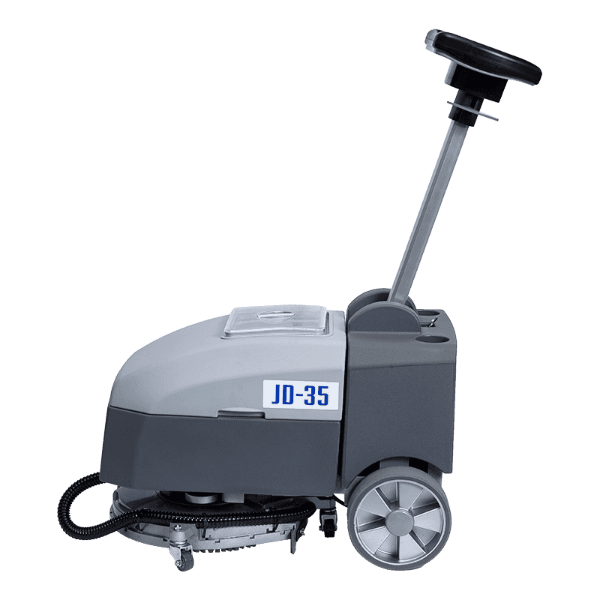
A walk-behind floor scrubber is manually guided by an operator walking behind the machine. It is widely used in medium-sized spaces where maneuverability and precision are required.
Ride-on Floor Scrubber
A ride-on floor scrubber allows the operator to sit and drive the machine. It is designed for large-scale cleaning tasks where coverage speed and operator comfort are priorities.
Key Differences Between Walk-behind and Ride-on Models
| Feature | Walk-behind Floor Scrubber | Ride-on Floor Scrubber |
|---|---|---|
| Operation Style | Operator walks behind | Operator sits and drives |
| Space Suitability | Small to medium areas | Large open areas |
| Maneuverability | High, ideal for tight spaces | Moderate, better for open layouts |
| Productivity | Medium coverage rate | High coverage rate |
| Operator Fatigue | Higher over long use | Lower due to seated operation |
| Storage Needs | Compact storage | Requires more storage space |
This comparison highlights that the selection depends more on environment structure than cleaning capability alone.
Application Scenarios
Different environments require different cleaning approaches. Choosing between walk-behind and ride-on models should be based on layout complexity and cleaning frequency.
Walk-behind Floor Scrubber Applications
- Retail stores and supermarkets
- Small warehouses
- Schools and healthcare corridors
- Manufacturing workshops with narrow aisles
- Parking areas with segmented zones
Ride-on Floor Scrubber Applications
- Large warehouses and logistics centers
- Airports and transportation hubs
- Shopping malls and exhibition halls
- Industrial production facilities
- Large parking structures
The key factor is whether the facility requires frequent turning and obstacle navigation or long uninterrupted cleaning paths.
Performance and Efficiency Considerations
When evaluating industrial floor cleaning machines, efficiency is not only about speed but also about resource optimization.
Walk-behind models generally provide:
- Better precision cleaning in tight layouts
- Lower energy consumption
- Easier maintenance access
- Flexible usage in multi-zone environments
Ride-on models typically offer:
- Higher cleaning throughput per hour
- Reduced operator fatigue in long shifts
- More consistent cleaning on large surfaces
- Improved water and detergent efficiency in large-scale cleaning
Selecting the right model ensures optimal balance between productivity and operational cost.
Cost and Operational Factors
While both systems are designed for commercial floor cleaning, their cost structures differ.
- Walk-behind floor scrubber systems usually require lower initial investment and are more suitable for businesses with moderate cleaning needs.
- Ride-on floor scrubbers involve higher investment but provide faster return in large-scale operations due to labor savings and productivity gains.
Additional factors to consider include maintenance complexity, training requirements, and battery or power consumption efficiency.
How to Choose the Right Floor Scrubber
Choosing between the two options should follow a structured evaluation:
Facility Size – Larger spaces favor ride-on systems.
Layout Complexity – Tight corners and obstacles favor walk-behind units.
Cleaning Frequency – High-frequency cleaning may justify ride-on investment.
Labor Availability – Limited labor may require more automated solutions.
Budget Planning – Balance upfront cost with long-term efficiency.
A proper assessment ensures the selected floor cleaning equipment aligns with both operational and financial goals.
Maintenance and Usability
Both scrubber types require routine maintenance to ensure long-term performance.
Common maintenance tasks include:
- Cleaning solution tanks after use
- Checking brushes or pads for wear
- Inspecting water recovery systems
- Charging and maintaining batteries
- Regular filter cleaning
Walk-behind systems are generally easier to service due to their compact structure, while ride-on machines may require more structured maintenance schedules.
FAQ
1. Which is better for small facilities, walk-behind or ride-on scrubber?
A walk-behind floor scrubber is generally more suitable for small to medium spaces due to its compact design and maneuverability.
2. Is a ride-on floor scrubber more efficient?
Yes, for large open areas, ride-on models provide higher productivity and reduce operator fatigue, making them more efficient in large-scale cleaning tasks.
3. Can both types clean the same surfaces?
Yes, both can be used on most hard floor surfaces, including concrete, tile, and epoxy floors, depending on brush selection.
4. What is the main advantage of a walk-behind floor scrubber?
Its main advantage is flexibility. It can clean narrow and complex areas where ride-on machines may not fit.
5. How often should a floor scrubber be maintained?
Routine maintenance should be performed after each use, with more detailed inspections conducted weekly or monthly depending on usage intensity.
A well-informed choice between walk-behind and ride-on floor scrubbers ensures efficient cleaning performance, optimized labor use, and improved facility hygiene standards.