

 English
 Español
 عربى
عربى

In facility management and industrial maintenance, labor expenses consistently represent the largest portion of cleaning budgets. Traditional mopping and sweeping methods require multiple passes, significant physical effort, and considerable time. An automatic walk-behind floor scrubber fundamentally changes this equation by combining scrubbing, washing, and drying into a single, efficient operation. This technology directly reduces manual labor requirements by up to 50%, allowing staff to reallocate their time to higher-value tasks while maintaining superior floor cleanliness.
Why Labor Costs Dominate Cleaning Budgets
Conventional floor cleaning typically involves sweeping, mopping, waiting for drying, and often repeated scrubbing for stubborn dirt. A 1,000-square-meter warehouse might require two hours of manual work. The same area cleaned with an automatic walk-behind floor scrubber takes approximately one hour or less, depending on model specifications. The labor cost saving stems from three factors: reduced cleaning time per square meter, elimination of multiple process steps, and less physical strain leading to fewer breaks and sick days.
How an Automatic Walk-behind Floor Scrubber Works
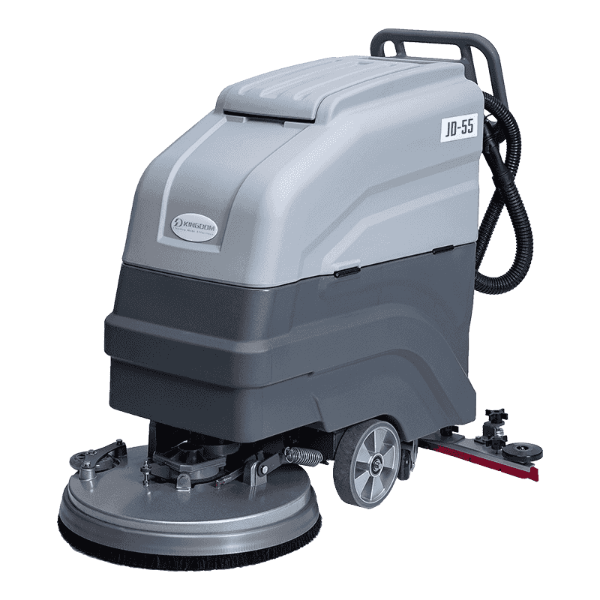
This equipment integrates a cylindrical or disc brush, a solution tank for cleaning detergent, a recovery tank for dirty water, and a squeegee drying system. The operator walks behind the machine, guiding it across the floor while the scrubber automatically meters cleaning solution, agitates the floor surface, and vacuums up the wastewater. The result is a clean, dry, slip-resistant floor ready for immediate use.
Key Features That Drive Labor Reduction
The following table outlines the specific features of a typical automatic walk-behind floor scrubber and their direct impact on labor efficiency.
| Feature | Function | Labor Impact |
|---|---|---|
| Simultaneous scrubbing and drying | Cleans and dries in one pass | Eliminates separate drying wait time |
| Adjustable brush pressure | Matches force to floor type | Reduces need for repeat passes |
| Large solution/recovery tanks (40–85 L) | Longer operation between refills | Fewer interruptions for refilling |
| Battery-powered operation | No cord management | Saves time untangling and moving cables |
| Automatic brush activation | Engages only when needed | Reduces operator fatigue and error |
| Squeegee drying system | Leaves floor dry instantly | Eliminates mop wringing and warning signs |
Each of these features contributes cumulatively to a 50% labor cost reduction, verified by operational studies across retail, healthcare, logistics, and manufacturing sectors.
Realistic Operational Scenarios
In a supermarket with 5,000 square meters of hard floor, a two-person team using mops and buckets spends about eight hours daily. One operator with a walk-behind floor scrubber completes the same area in four hours, freeing the second employee for shelf stocking, window cleaning, or waste management. The annual labor cost saving easily offsets the equipment investment.
For an office building with corridors, lobbies, and cafeterias, night cleaning crews often rush to finish before morning. An automatic floor scrubber reduces physical exertion and produces consistent results, so managers can cover more square meters with fewer staff. Many facilities reassign saved labor hours to deep cleaning tasks that were previously postponed indefinitely.
Selecting the Right Model for Maximum Savings
When evaluating walk-behind floor scrubbers, focus on cleaning path width, tank capacity, battery runtime, and ease of maintenance. A wider path (e.g., 65 cm vs. 45 cm) covers more area per pass but may be less maneuverable in tight spaces. Tank capacity determines how often you stop to refill solution or empty recovery water; larger tanks support continuous operation for longer shifts. Battery runtime must match the planned cleaning window, typically 2–4 hours for most facilities, though heavy industrial sites may require 6+ hours of continuous use.
No brand names or specific company claims are necessary to recognize that modern automatic scrubbers offer robust performance. Instead, compare technical specifications from multiple suppliers, request demonstration units, and measure actual cleaning time reductions on your own floor surfaces.
Maintenance and Long-term Cost Considerations
While the focus is labor cost reduction, proper maintenance extends equipment life and preserves efficiency gains. Daily rinsing of the recovery tank and squeegee blades takes less than five minutes but prevents clogs that slow cleaning speed. Weekly brush inspections and battery charging protocol adherence keep the scrubber operating at peak performance. Many users schedule maintenance as part of a 5-minute pre-shift checklist, which itself reduces downtime compared to reactive repairs.
Long-term labor savings remain stable only if the machine runs reliably. Simple maintenance routines ensure the automatic walk-behind floor scrubber continues to deliver 50% labor reductions year after year.
Conclusion
Transitioning from manual mopping to an automatic walk-behind floor scrubber represents one of the most measurable operational improvements for any facility with hard flooring. The combination of simultaneous cleaning and drying, operator-friendly controls, and extended runtime directly cuts labor hours by half. This saving allows managers to either reduce staffing costs or redirect human resources to tasks that truly require judgment and dexterity.
FAQ
1. Can a walk-behind floor scrubber operate on all floor types?
Yes, most automatic walk-behind floor scrubbers work on tile, concrete, epoxy, vinyl, and sealed wood. Adjustable brush pressure and pad types allow safe use on delicate or textured surfaces. Always check the manufacturer’s guidelines for specific floor compatibility.
2. How long does it take to train an employee to use an automatic floor scrubber?
Most operators become proficient within one hour of hands-on training. Basic controls include speed adjustment, brush activation, and solution metering. Advanced features like programmable cleaning modes require about 30 additional minutes of instruction.
3. Is the claimed 50% labor cost reduction realistic for small areas (under 500 m²)?
For very small areas, the absolute labor saving may be less dramatic because setup and machine rinsing take proportionally more time. However, relative improvement often exceeds 40% compared to manual mopping. For areas under 200 m², a smaller automatic scrubber or even a manual spray-and-vacuum unit might be more cost-effective.
4. What ongoing costs should I budget besides the initial purchase?
Plan for replacement brushes or pads every 3–6 months depending on use, squeegee blades every 6–12 months, and battery replacement every 3–5 years. Cleaning solution costs remain similar to manual mopping. Regular maintenance consumes less than 5% of the labor savings generated, so net positive cash flow starts quickly.
5. Can one automatic walk-behind floor scrubber replace multiple cleaning staff?
It typically replaces one full-time equivalent position per shift, depending on floor area. For example, if three workers previously cleaned a facility in six hours, one operator with a scrubber might clean it in three hours, freeing the other two staff for different duties. The machine augments, not eliminates, all roles—but it reallocates labor from repetitive mopping to more skilled tasks.